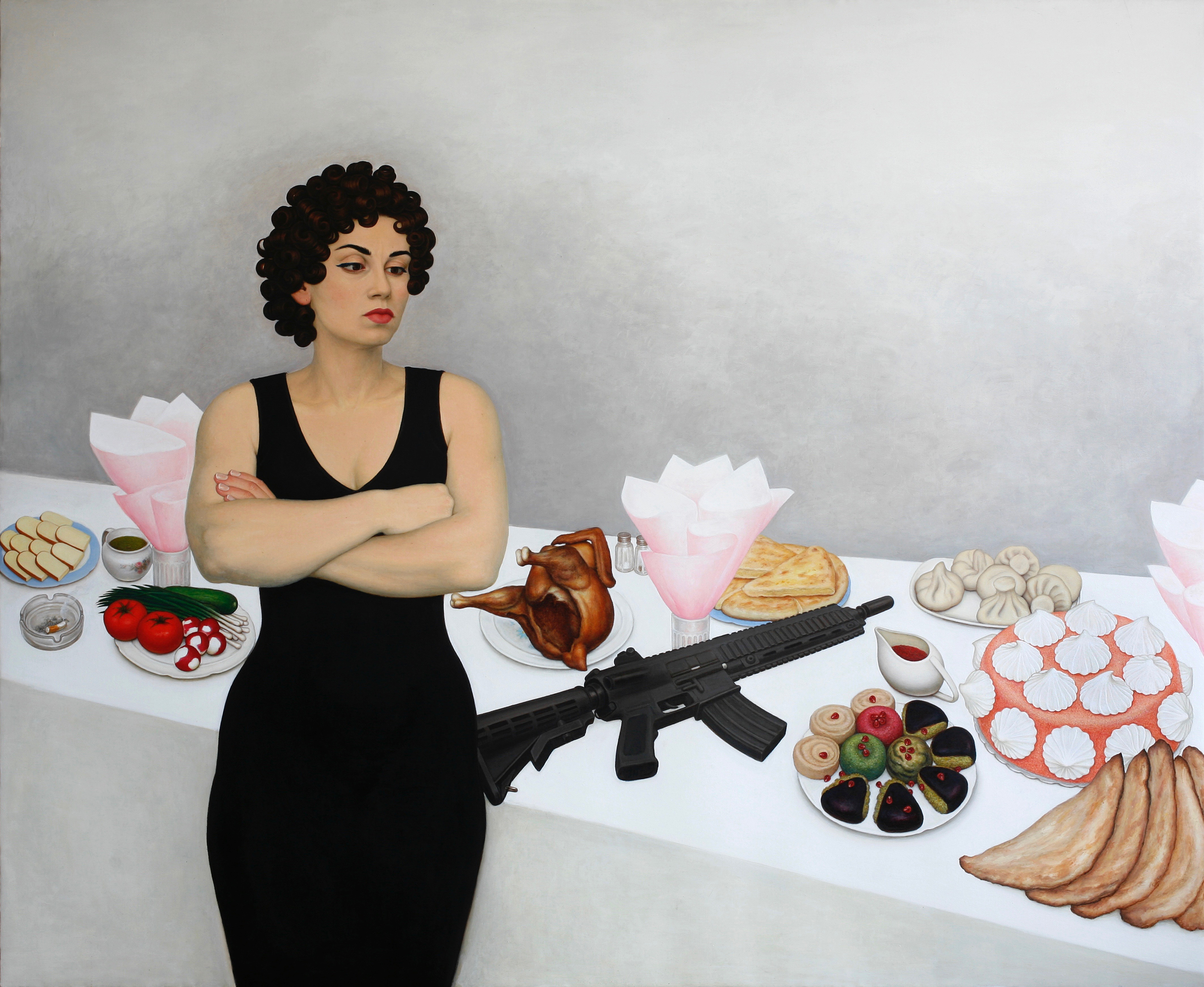
In Black 2013 Oil on linen 78 x 64 in. (198 x 162.5 cm)
It's 3:00 p.m. Guests will be arriving in a few hours. Her eyes couldn't resist glancing at the newspaper headline:
"What Exactly Does Russia Want, Anyway?"
Her eyes kept drifting back to the article beneath the headline:
"Unfortunately, despite calls from the international community, the Russian Federation continues to violate the principles of international law and the obligations it assumed under the ceasefire agreement. Occupation forces in the village of Ditsi, in the Gori district, have resumed installing barbed-wire fences…"
…
It's time to prepare the Supra (the traditional Georgian feast).
From left to right, she carefully arranges slices of smoked Sulguni cheese, tomatoes, cucumbers, green onions, and green Tkemali—tart green plum sauce. On the right side of the table, she places red Tkemali in a Japanese porcelain bowl. In the center she sets down the broiled chicken, Khachapuri—Georgian cheese bread—a large platter of assorted Pkhali: eggplant, beets, sweet red peppers, and spinach blended with crushed walnuts. A huge cake. Khinkali—dumplings filled with pork and beef. Lavash bread, baked the old way in a large clay oven.
Time to get dressed.
She opens the closet and gazes at the dress sprinkled with red dots—the one she longs to wear. But once again, she puts on the black one instead and prepares herself to welcome the guests.
On the fortieth day after the death of a loved one, in Georgia, as throughout the Caucasus, a large memorial dinner called Ormotsi ("Forty") is held to mark the end of the mourning period. Only after this gathering may the deceased's close relatives remove their black clothing. Those who observe the tradition more strictly will continue wearing black for an entire year.